I just saw a headline saying that China is ahead of the U.S. in developing artificial intelligence weapons.
What?
I imagine some computer deciding how to use weapons to kill people and destroy things. This sounds way too much like The Matrix. Computer driven tanks or planes could engage each other in battle, and we could just watch it all play out.
This also sounds like Robo-Cop. Some artificial intelligence machine could be used to take out enemies, both military and political. How can you survive interrogation by a computer? How could we let military decisions be made by any non-human entity?
Maybe I'm exaggerating the threat of these weapons. Or maybe these kinds of weapons should be banned like chemical weapons. It seems like the risks are far too great for us to start heading down this path.
If the Chinese are ahead of the U.S. in developing these weapons, then that means we are developing them too. Maybe we should rethink that.
Showing posts with label war. Show all posts
Showing posts with label war. Show all posts
Tuesday, January 29, 2019
Monday, January 7, 2019
Policing the World
America has 294 foreign embassies, in all but four countries around the world. By some estimates there are more than 40 armed conflicts globally. And the U.S. has picked winners in virtually all these conflicts. We offer foreign aid, influence government policies, and bring in soldiers. We want to promote freedom, human rights, democracy, and free markets.
We have enough resources to exert huge influence. And we use it.
But that influence might not always be the best. We could actually use our influence to benefit ourselves rather than other countries. ("America first.") We could be mistaken about what would be beneficial to other countries. We might not actually understand all the political, social, cultural or economic dynamics involved in other regions.
While we should help the world to be a better place, we may be overzealous in our desire to shape the world. Being the world's police is a heavy responsibility. Probably more than one country can manage.

We have enough resources to exert huge influence. And we use it.
But that influence might not always be the best. We could actually use our influence to benefit ourselves rather than other countries. ("America first.") We could be mistaken about what would be beneficial to other countries. We might not actually understand all the political, social, cultural or economic dynamics involved in other regions.
While we should help the world to be a better place, we may be overzealous in our desire to shape the world. Being the world's police is a heavy responsibility. Probably more than one country can manage.


Wednesday, September 23, 2015
Yogi's Joy
I was sad to learn today of the passing of baseball great Yogi Berra. His joy seemed contagious. I never saw him play, not even on TV. And I don't watch much baseball anyway. (Hey, the playoffs are coming soon. It's time for me to tune in.) And I've never been a Yankees fan.
Life experiences helped Yogi keep baseball in proper perspective. He served in the U.S. Navy during World War II, and fought in the D-Day invasion in 1944. He had seen real war, and likely faced down death. That's the perspective he brought to his game.
He set all kinds of baseball records and won many World Series. But his joy stands out as an enduring legacy. In nearly every picture published today, he grins ear to ear. This smile radiates from his soul. It's not posed, not faked. You can tell. He's at ease with himself and the world.
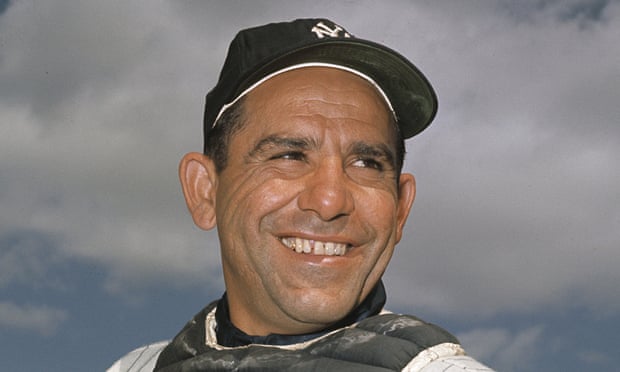
Yogi never took himself too seriously. He took baseball just seriously enough. That gave him the freedom to see the world through child-like eyes. His contradictory proverbs have become part of the American lexicon. In one of my favorite stories, a family was touring a museum exhibit about Berra, when they happened upon the man himself. They implored him to share a bit of Yogi-wit. Berra was taken aback with such a request. He responded, "I can't just make 'em up on the spot like that. If I could make 'em up like that, I'd be famous."
Rest in peace Lawrence "Yogi" Berra. If we could have joy like that, we wouldn't care about being famous or any of the small things.
Life experiences helped Yogi keep baseball in proper perspective. He served in the U.S. Navy during World War II, and fought in the D-Day invasion in 1944. He had seen real war, and likely faced down death. That's the perspective he brought to his game.
He set all kinds of baseball records and won many World Series. But his joy stands out as an enduring legacy. In nearly every picture published today, he grins ear to ear. This smile radiates from his soul. It's not posed, not faked. You can tell. He's at ease with himself and the world.
Yogi never took himself too seriously. He took baseball just seriously enough. That gave him the freedom to see the world through child-like eyes. His contradictory proverbs have become part of the American lexicon. In one of my favorite stories, a family was touring a museum exhibit about Berra, when they happened upon the man himself. They implored him to share a bit of Yogi-wit. Berra was taken aback with such a request. He responded, "I can't just make 'em up on the spot like that. If I could make 'em up like that, I'd be famous."
Rest in peace Lawrence "Yogi" Berra. If we could have joy like that, we wouldn't care about being famous or any of the small things.
Thursday, June 11, 2015
The Outcry for Good Work
Gallop CEO Jim Clifton has written a book called, The Coming Jobs War. In it, he suggests that wars in the near future will be fought for the sake of jobs. In an interview about his book, he cites the "Arab Spring" as an example of the uprising of the frustrated masses. A good job, he says, is a job working 30+ hours per week with a steady paycheck from an employer.
People want jobs. They want to feed their families. They want stability.
 Clifton further says that a great job is one in which the employee believes that the boss cares about the employee's development, the employee uses his strengths, and the employee believes that her contributions are making a difference.
People want their lives to have meaning.
All around the world, people will settle for a good job, and so few have a great job. Clifton estimates that less than half the world's work force has even a good job. The real unemployment rate, he says, is well over 50%.
Shockingly, Clifton believes that wars will be fought over jobs. Yet governmental leaders fail to realize the need. Governments on the local level need to clear the way for entrepreneurs to begin businesses, eliminating needless regulations and burdens.
Refreshingly, Clifton believes that free enterprise will lead the way to good and great jobs. I wholeheartedly agree. When individuals are free to put their strengths to work, and reap the benefits of their work, the world also benefits. This system only works well, Adam Smith would warn us, when people are guided by ethics and morality.
Maybe this war can be averted.
People want jobs. They want to feed their families. They want stability.
 Clifton further says that a great job is one in which the employee believes that the boss cares about the employee's development, the employee uses his strengths, and the employee believes that her contributions are making a difference.
 People want their lives to have meaning.
All around the world, people will settle for a good job, and so few have a great job. Clifton estimates that less than half the world's work force has even a good job. The real unemployment rate, he says, is well over 50%.
Shockingly, Clifton believes that wars will be fought over jobs. Yet governmental leaders fail to realize the need. Governments on the local level need to clear the way for entrepreneurs to begin businesses, eliminating needless regulations and burdens.
Refreshingly, Clifton believes that free enterprise will lead the way to good and great jobs. I wholeheartedly agree. When individuals are free to put their strengths to work, and reap the benefits of their work, the world also benefits. This system only works well, Adam Smith would warn us, when people are guided by ethics and morality.
Maybe this war can be averted.
Monday, January 12, 2015
Pondering the Greats of Battle
Winston Churchill once said, "History will be kind to me, for I intend to write it." Indeed many have noted that history is written by the victors.
But some military victors are known as evil, while some are thought of as brilliant and benevolent. Alexander the Great conquered much of the world and is lauded for spreading Greek culture around the Mediterranean. Julius Caesar conquered most of Europe and is remembered as a hero. William the Conqueror is hailed as the last military leader to invade Britain in 1066.
 Meanwhile, Attila the Hun, Genghis Kahn, Napoleon Bonaparte, and Adolf Hitler are known as brutal warriors, villains of history.
All of these military men led huge offensive killing operations, yet some are remembered as "great," some as evil. Of course historians will differ on their assessments of leaders, and probably have more objectivity as the centuries go by. In the South, General William Sherman is remembered as brutal, cruel, and needlessly destructive in his march through Atlanta in the Civil War. But his decisive blow to the Confederacy wiped out any hope for the South to win the war.
What sets the good conquerors
apart from the bad? I have not done much historical research here, but I have some ideas.
Leaders are judged by their methods. Unusual cruelty hurts a warrior's reputation in history.
Leaders are judged by their motives. Alexander believed that he was bringing good to the lands he conquered, and history seems to agree.
Leaders are judged by the culture they advance. Warriors who promote freedom find more favor than those who bring tyranny.
In the short run, it is hard to think of offensive, killing, conquering operations as good. Yet the long run of history lauds countless military campaigns. History, of course, is written by the victors.
Ultimately, God will be the judge of history. Scripture even calls God a Warrior. I look forward to understanding the truth.
But some military victors are known as evil, while some are thought of as brilliant and benevolent. Alexander the Great conquered much of the world and is lauded for spreading Greek culture around the Mediterranean. Julius Caesar conquered most of Europe and is remembered as a hero. William the Conqueror is hailed as the last military leader to invade Britain in 1066.
Meanwhile, Attila the Hun, Genghis Kahn, Napoleon Bonaparte, and Adolf Hitler are known as brutal warriors, villains of history. All of these military men led huge offensive killing operations, yet some are remembered as "great," some as evil. Of course historians will differ on their assessments of leaders, and probably have more objectivity as the centuries go by. In the South, General William Sherman is remembered as brutal, cruel, and needlessly destructive in his march through Atlanta in the Civil War. But his decisive blow to the Confederacy wiped out any hope for the South to win the war.
What sets the good conquerors
apart from the bad? I have not done much historical research here, but I have some ideas.
Leaders are judged by their methods. Unusual cruelty hurts a warrior's reputation in history.
Leaders are judged by their motives. Alexander believed that he was bringing good to the lands he conquered, and history seems to agree.
Leaders are judged by the culture they advance. Warriors who promote freedom find more favor than those who bring tyranny.
In the short run, it is hard to think of offensive, killing, conquering operations as good. Yet the long run of history lauds countless military campaigns. History, of course, is written by the victors.
Ultimately, God will be the judge of history. Scripture even calls God a Warrior. I look forward to understanding the truth.
Subscribe to:
Posts (Atom)